
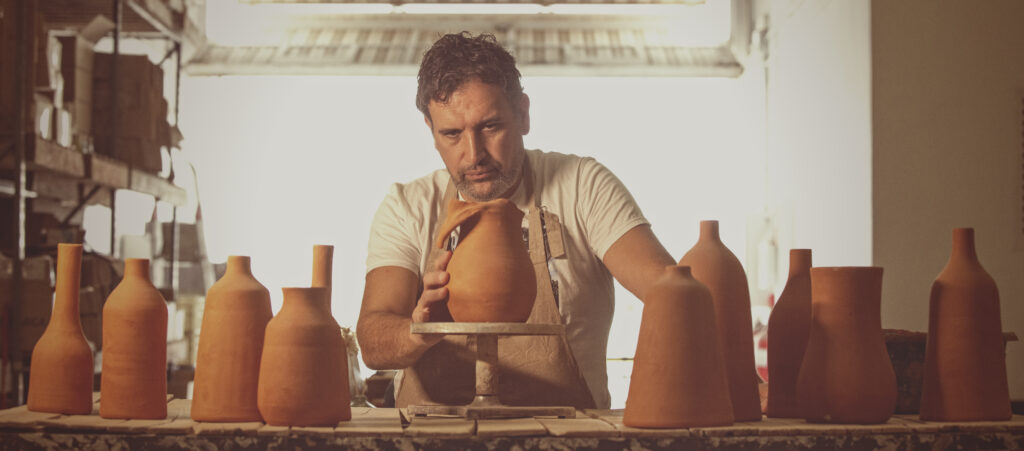
Contemporary ceramic sculpture in Spain is experiencing a renewed presence within the international art and design landscape. Clay, traditionally associated with craftsmanship and functional objects, has become a powerful medium for contemporary artistic expression. Spanish artists are increasingly exploring ceramics as sculpture, combining ancestral techniques with new approaches to form, surface, scale and materiality.
From Seville, Spain, ceramic artist Marco Terranova develops a distinctive body of work rooted in the Mediterranean and centred on the transformation of wheel-thrown forms into contemporary sculpture. His practice brings together the technical knowledge of pottery, the freedom of sculpture and a visual language influenced by the landscapes, architecture and cultural memory of the Mediterranean.
At the heart of Terranova’s work is the potter’s wheel. Traditionally used to create symmetrical and functional vessels, the wheel becomes the starting point for a more experimental process. Forms are thrown, altered, opened, stretched and transformed until their original function becomes secondary. What begins as a vessel can evolve into an autonomous sculptural object.
This dialogue between ceramics and sculpture defines his artistic practice. Rather than abandoning the ceramic tradition, Terranova uses its techniques as the foundation for contemporary exploration. The circular movement of the wheel remains visible in many pieces, preserving traces of their making while allowing the finished works to move beyond conventional pottery.
The Mediterranean plays a central role in this visual language. Working in Andalusia and drawing on his Spanish and Italian cultural background, Terranova explores a territory shaped by centuries of exchange between Southern Europe, North Africa and the Eastern Mediterranean. Ancient vessels, archaeological fragments, whitewashed architecture, weathered walls, mineral surfaces and coastal landscapes become references without being literally reproduced.
Material and surface are equally important. Terracotta, high-temperature firing and individually developed glazes create surfaces in which colour, texture and fire interact. The firing process introduces an element of transformation that cannot be entirely predetermined. Subtle variations, irregularities and traces of heat become part of the identity of each work.
This approach places Marco Terranova within the broader field of contemporary Spanish ceramics, while giving his work a recognisable Mediterranean identity. His sculptures explore the boundary between vessel and object, tradition and experimentation, control and chance.
Spain has a long and diverse ceramic heritage, from ancient Mediterranean pottery and Islamic ceramics to regional traditions that remain active today. Contemporary ceramic art builds upon this history while moving beyond the traditional distinction between craft and fine art. In this context, clay becomes a medium for sculpture, installation and artistic research.
For Terranova, this connection with tradition does not mean looking backwards. Instead, historical ceramic knowledge provides a vocabulary from which new forms can emerge. The wheel becomes an origin rather than a limitation.
Created as individual artworks, his contemporary ceramic sculptures and sculptural vessels are conceived for private collections, galleries, architectural projects, interior design and hospitality spaces. Their material presence allows them to exist both as autonomous artworks and in dialogue with contemporary architecture and interiors.
From his studio in Seville, Andalusia, Marco Terranova continues to develop a body of work that connects Spanish contemporary ceramics with a wider international conversation around clay and sculpture. Through wheel-thrown construction, transformation, glazing and fire, his work investigates how one of humanity’s oldest materials can continue to produce new artistic languages.
Marco Terranova’s contemporary ceramic sculpture ultimately emerges from a meeting of opposites: tradition and experimentation, geometry and imperfection, vessel and sculpture, earth and fire. Rooted in Spain but shaped by a broader Mediterranean perspective, his work presents ceramics as a contemporary sculptural language capable of connecting material, memory and place.